 Journal Archive
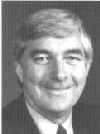
The President of the Police Association of South Australia publishes his 'message' in the Police Journal every month. The messages of the president, Peter Alexander, follow.

PRESIDENT'S MESSAGE - DECEMBER 1997
To suggest that the Police Association has concerns about the Police Complaints Authority investigation into the allegations by Wayne Matthew MP is to understate our position.
We find it extraordinary that after making his allegations in Parliament, Mr Matthew was able to negotiate with the PCA on the wording of the final report and then selectively leak its findings to the media.
The serious allegations made by Mr Matthew were, of course, refuted. We must ensure that public confidence in the Police Force has not, in any way, been diminished by the unsubstantiated allegations made by the Member for Bright.
The Association has raised its concerns regarding the role of the PCA and its methods of operation with the Attorney General. As a result, a meeting has been planned for 18th December with the Attorney General, Crown Solicitor, Police Complaints Authority, Police Association officials and our legal advisers.
It is important that we have an independent overview of police accountability and that the public and their Police Force have confidence in the process that provides that accountability.
What we do demand is a fair go for our members in the most accountable of all occupations and protection from the vexatious complainant.
Peter Alexander
President
PRESIDENT'S MESSAGE - NOVEMBER 1997
At the time of writing, the Association has lodged a dispute in the South Australian Industrial Commission regarding the Police Department's proposed changes to rosters and work practices. This dispute is not simply about station closures - it is about the structures and work practices that the Police Department intends to implement.
In understanding this dispute, it is important to revisit the current Enterprise Bargaining Agreement that was ratified in December 1995. At that time it was agreed to negotiate a wide range of issues. One of those issues was revised shiftwork and rostering arrangements. The inclusion of that provision does not allow the Police Department to introduce arbitrary change.
During the life of the agreement we have seen a number of outcomes including:
Civilianisation.
Outsourcing.
Targeted separation packages.
Time off in lieu.
Extended shifts in COMCEN.
The Police Department, after failing to reach agreement on change, both
at the Consultative Committee level and in direct negotiation with the
Association, has now moved to impose rosters and work practices without
agreement. The Police Department has demonstrated a lack of commitment
to Enterprise Bargaining and an inability to think beyond the command-and-control
mentality.
The State Government has introduced, within the Public Sector, a policy
of Enterprise Bargaining. The Police Department, in the face of this policy,
has reverted to managerial prerogative and award regulation.
The Association will continue to act to protect the interests of all members.
Peter Alexander
President
PRESIDENT'S MESSAGE - OCTOBER 1997
In the lead up to the election both major parties have indicated their intention to support and properly resource the Force. The Association has the obligation to ensure that these commitments are kept regardless of which party wins the election on 11th October.
Members are aware of the importance of the Upper House remaining a house of review and not becoming a rubber stamp for the party with the numbers in the House of Assembly. No Government has had control of the Upper House in this State for 27 years and the Association would like to see that remain the case so that legislation affecting our members is subject to proper scrutiny and debate.
The Association is not and never has been party political. The Association will work with the soon- to-be-elected Government in the best interests of members of the Force and the community they serve.
Peter Alexander
President
PRESIDENT'S MESSAGE - SEPTEMBER 1997
In April, 1997, in the matter of R V Terry Ian Polley (1997) unreported, the South Australian Supreme Court -- Court of Criminal Appeal considered legal argument regarding the availability of police officers' records at the Police Complaints Authority (PCA).
The defendant was charged with offences against the Controlled Substances Act, 1984. The defendant's counsel sought access to the (PCA) records of police witnesses at the trial in order to assess their usefulness in assisting attacks on the officer's credibility.
The Court decided, in essence, that in certain circumstances police officers' Police Complaints records are discoverable by subpoena in criminal trials. The Court did not give an open licence and stated that there must be a legitimate purpose in seeking the information (i.e. not a fishing expedition). Also, the Court retains a discretion as to discovery of the records. The Court considers the competing interests of the defendant and those of secrecy/confidentiality of the records in the exercise of this discretion and will usually inspect documents in the course of these considerations. Notwithstanding this, the judgement is a matter of concern for all police officers and the outcome is unacceptable in the Association's view.
What is particularly worrying is the fact that it is not only actual assessments of the PCA, where a negative finding against a police officer has been made, that are potentially discoverable, but complete complaints histories. This, of course, means that the mere fact that members who work in roles which of themselves are conducive to complaints and have had numerous baseless and unproven complaints made against them, could be used as a means to attack their credibility. It raises the possibility of people/groups orchestrating complaints against members for potential use in court proceedings. The decision also means, by analogy, that some personnel records of police officers, as held by the Police Department, are equally accessible.
Also, although the decision in Polley was in the criminal jurisdiction, attempts have been made to access PCA records in an on-going civil matter involving our members.
The Association believes, as a matter of public policy, that the Police Complaints or personnel records of police officers should not be discoverable in the course of court proceedings under any circumstances. Suitable amendments should be made to both the Police Act and the Police Complaints and Disciplinary Proceedings Act, to remedy the unacceptable ramifications of the Court's decision.
The Association has raised this issue with the Attorney General and awaits his response.
Peter Alexander
President
PRESIDENT'S MESSAGE - AUGUST 1997
The existing Enterprise Agreement covering South Australian police officers expires in December, 1997. As the Association develops its position in relation to a new agreement, I ask all members to reflect on the reasons for the successful conclusion to the first round of Enterprise Bargaining.
I firmly believe that the reason the Association achieved such a successful result was not only due to the merit of our claim, but also the collective strength and solidarity of members of the Police Association.
There is no doubt that the same commitment and unity displayed during the first Enterprise Bargaining process will be required for future negotiations. Likewise, our collective power will be vital in responding to changes associated with the reorganisation of the Police Service as proposed by the Commissioner of Police.
I invite the small number of police officers who are not currently members of the Association to seriously consider their position. Is it right that you should prosper from the efforts and financial contributions of others?
The Association organiser, Mark Carroll, will be contacting all non-members in the near future to discuss their status. Mark will be pointing out the distinct benefits of Association membership and, hopefully, convincing non-members to rejoin so they too can make a contribution to the working lives of South Australian police.Peter Alexander
President
PRESIDENT'S MESSAGE - JULY 1997
Impending Changes to Police Discipline Procedures
Negotiations between the Association and Police Department regarding changes to current Police discipline processes are well advanced. Substantial agreement has been reached on key areas of change to the Police Act and Regulations.
Changes to disciplinary procedures have taken place independently of human resource/conditions of employment issues.
Important changes to the current scheme will include the introduction of a two-tiered disciplinary system in which minor matters will be dealt with internally in a corrective - managerial fashion. Importantly, minor transgressions will not be punished with the only remedies possible being corrective/managerial in nature. Allegations of serious matters will continue to be dealt with as they currently are, with Police Disciplinary Tribunal presiding over trials when necessary.
Another important change will see many current offences under Regulations (which are clearly outdated and inappropriate) eliminated and replaced with a Code of Conduct. The development of the Code of Conduct has now become part of the Department's Focus 21 project. During negotiations towards the contents of the Code, the Association will consult widely with members to seek their ideas and input so that the eventual Code best reflects the rights, responsibilities and demands faced by today's police officers.
Peter Alexander,
President
PRESIDENT'S MESSAGE - JUNE 1997
The Association acknowledges the right of the Police Commissioner to determine the structure of the Police Force and does not oppose the general concept of the Focus 21 proposal.
The Association will, however, protect the interests of its members during the process of change announced by the Police Commissioner. This includes maintenance of rank and salary for affected members, preservation of promotional opportunities, minimisation of the impact of redeployment on members and their families and the many other issues that arise out of the proposals outlined.
We have been assured by the Commissioner that full consultation will take place and the Association has put its own Project Team in place to ensure that the voice of the members is heard on issues that affect them throughout the process.
It is also important that the public of South Australia continue to receive the best police service in the country, and there is no doubt that the Association has a role to play in that debate.
None of us likes change but change is inevitable and the Association and its membership are organised to meet the challenges ahead.
Peter Alexander,
President
PRESIDENT'S MESSAGE - MAY 1997
ALLOWANCES IN LIEU OF PENALTIES
As members are aware the South Australia Police Department Enterprise Agreement provides for:the implementation of a standard percentage loading for shiftworkers, that will
provide for shiftworkers to receive a standard loading for all day, afternoon and night shifts worked (including weekends);It was the intention of the parties to the agreement that this would be done by 1 March 1996. Obviously this has not happened. In fact little negotiation has taken place.
Despite sporadic discussions in early 1996 and again in early 1997 about possible models and definitions, no offer has been made by the Department.
The Association's position has remained consistent throughout the process; no member should suffer a reduction in take home pay and appropriate safeguards should be put in place to prevent excessive shifts being worked.
SUPER CHANGES - 100% COMMUTATION
The regulations covering commutation of pensions to lump sums in the Police Superannuation Act have been amended to allow 100% commutation of retirement pensions. The 50% limit will still apply to invalidity and retrenchment pensions.
This issue was first raised by the Association with the Government in early 1995 and has been pursued consistently since then. The new regulations were finally proclaimed on 10 April 1997.
Peter Alexander
President
PRESIDENT'S MESSAGE - APRIL 1997
On March 7, 1997, the Full Bench of the Supreme Court of South Australia handed down its decision in the State of South Australia v Brophy.
The case involved a question of whether our member, who was travelling to his home address after completing his shift and who was in uniform, riding a police motorcycle, equipped with a firearm and baton and monitoring police communications as directed, was covered by the provisions of the Workers Rehabilitation and Compensation Act 1986.
The Court decided he was not.
The Court decided that amendments to the 'journey accident' provisions of the legislation had the effect of excluding a person in the circumstances of our member.
The effect of the Court's decision is far from definitive. Obviously the decision means that motorcycle police are clearly at risk of non-compensable journey accidents but also the question of compensation entitlements of other police officers in a range of journey situations is unclear.
The Association is considering a range of options to remedy this unacceptable situation. Part of any solution must involve negotiations with the Police Department.
We will keep members advised of the progress of this important issue.
Peter Alexander
President
[Back to the page index]
PRESIDENT'S MESSAGE - MARCH 1997
The recent acquittal in the Magistrates Court of a man charged with assaulting Constable Mark Jackman in Hindley Street is a cause of concern to the Association and the community.
The Defendant admitted punching our member but was acquitted on the basis of a plea of self defence under the provisions of Section 15 of the Criminal Law Consolidation Act.
The Association has called on the Government to amend Section 15 of the Act and introduce a requirement of reasonableness. South Australia is one of the only jurisdictions in Australia without such a test.
There is no undue onus on the community in demanding that in defending themselves or others or their property that they act reasonably. The Association is exploring the potential for Constable Jackman to take civil action.
Police Officers like Mark Jackman are continually exposed to danger in the course of their duties. It would be a tragedy if the law was not amended to give protection to our members and the community.
PETER ALEXANDER
PRESIDENT
PRESIDENT'S MESSAGE - FEBUARY 1997
The Association will continue to fiercely pursue the issue of staffing levels. We will do so not only in the interest of our members but also in the public interest.
There has been a reduction of Police numbers as a result of civilianisation and outsourcing initiatives as well as Targeted Separation Packages. Those changes to staffing levels have taken place as a result of the Enterprise Agreement.
The current staffing level problem is not due to the reductions from the EB process but is the result of a political decision to reduce the size of the force by not recruiting against natural attrition.
The Police Department like other large organisations has a consistent turnover of staff as a result of retirement, resignation and other reasons. The average rate of that turnover is 115 per year. On that basis, in order to maintain the status quo staffing level, the Department is required to recruit 115 Trainees per year. This is not being done and as a result our members are delivering normal police services with ever decreasing staffing levels.
This situation cannot continue and the Association will do all possible to ensure an appropriate result.
PETER ALEXANDER
PRESIDENT
PRESIDENT'S MESSAGE - JANUARY 1997
The new Commissioner is to be congratulated and given loyalty and support. He in turn must provide the appropriate leadership and support to the membership.
There needs to be an acceptance that morale within the force needs to be lifted and the placing of emphasis on the greatest resource we have, THE HUMAN RESOURCE
I can find no better words for the beginning of a new era than the following that arrived at the Association anonymously: -"The Police service might well be better served by concentrating on its core business and those practitioners who perform the core business rather than by arbitrarily and randomly introducing a stream of new strategies and policies"
I hope 1997 is a good year for us all.
PETER ALEXANDER
PRESIDENT