 Journal Archive
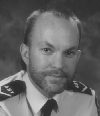
Mark Carroll knows he might have to pay a price for his dedication to the membership of the Police Association. Recently appointed the Association's new organizer, Carroll was seconded from SAPOL (South Australia Police) in July this year.
But before he won and accepted that position, he was warned that, "to cross the line" from employer to union may do little to enhance his police career path.
"It was obviously on my mind when I made my decision (to join the Association)," he says, "because, more than likely, any door that may have been open in the Department will, more than likely, be closed after spending some time here."
Carroll won't know for some time how far-reaching the effect on his police career will be, as his return to SAPOL seems unlikely before next century.
In the meantime, he's determined to give his new employer "my all". "(And) if that's to the detriment of the South Australia Police Department or, my police career," he says, "then so be it - I'm not worried about that."
Carroll's police service is part of a long family tradition: all but one generation of his family, from his great-grandfather down, has produced South Australian police officers.
And, with 12 years' policing experience of his own, and five years as a member of the Association's committee of management, Carroll, 30, brings valuable expertise to his new job. He's also part-way through a Bachelor of Labour Studies degree at Adelaide University.
He relishes the opportunity for face-to- face contact with members in the field to ascertain their views on future directions for their union. He'll relate those views directly to Police Association president, Peter Alexander, and the committee of management.
Carroll's responsibilities will also include assisting members with workplace grievances and identifying the training requirements of workplace representatives.
But he isn't overawed by those responsibilities: he loves his new role and welcomes the challenge. And now, having had first-hand experience of the Association's immense workload, he has a new appreciation of the frantic pace at which the organization and its employees operate.
He's also ever-mindful of Association history and those police unionists who came before him. He speaks of their efforts in deeply respectful tones. "They sweated a lot of blood and tears to get the conditions that we have at the moment, and a lot of those conditions are under attack," he exclaims.
Of course, Carroll recognizes that occasional clashes with SAPOL management will inevitably occur as he plays his part in protecting members' rights and conditions.
"They (managers) have tried to bring in things that, personally, I don't agree with and, from what I'm hearing, members don't agree with either."
Recent roster trials enforced by SAPOL, and some consultative committees which, Carroll says, are being "absolutely ridden roughshod over by managers", cause him great concern. He says that some rosters under consideration are regressive and wonders about their application in South Australia.
"Just because it (a roster) happens in another state or jurisdiction doesn't mean that it's necessarily good for this department" he says. "And, in the process of changing the way people work, you'd first want to identify to them the reasons why you want to change - that hasn't been done."
Carroll expects to make "a few enemies" during his term as organizer. But his focus is firmly fixed on the many Association members whom he sees as anguished by the tide of change sweeping across the Police Department.
"They (members) are looking towards the Association for leadership," he says. "Our greatest objective will be ensuring that any change that takes place follows an agreed framework. Unless that happens, there's going to be a lot of disillusionment among the membership."
Empowered and aware of their ability to make a difference is how Carroll wants to see Association members. So, not surprisingly, meeting with the few police officers who aren't members is also on his agenda. He wants to discover their reasons for non-membership and explain the advantages of acting collectively rather than individually.
"It's the same old story," he says, "united we stand, divided we fall. We won't always win, but at least they (members) will know that we're fighting the good fight."[End]