 Journal Archive
The Police Association of South Australia Feature story - July 1997
[Volume 78, number 7]Police Journal features writer, Brett Williams, brings us two stories this month - Sniffing Out Enemy Substances discusses the SAPOL (South Australia Police) drug detection dogs and Police Association's Newest Life Member cronicles the contributions made by Bob Wohlenberg our recently retired Vice-President.
by Brett Williams
Police drug dogs, Zenna and Vashti, can find cannabis stashed in houses in only seconds. So acute is their sense of smell that they can detect quantities of the drug as small as one seed. And the two Labradors aren't foiled by criminals' hiding places such as wall cavities, ceilings or space beneath floorboards.
Donated to SAPOL (South Australia Police) by Australian Customs Services in 1994, the dogs' relatively small size, outgoing nature and "frantic-retrieving" instinct make them ideally suited to drug detection work.
And their skills extend well beyond the detection of cannabis. Locating amphetamines, cocaine and heroin are tasks of which they're just as capable. Even money which has absorbed the odour of drugs after being handled by dealers draws the dogs' highly sensitive noses.
Senior Constables Peter Crouch (Zenna) and Steve Taylor (Vashti), learned the art of handling the dogs during a three-month course with Australian Customs in Canberra in 1994.
And contrary to popular belief, dogs don't become adept drug detectors through substance addiction. It's simply a case of storing rolled-up towels in a safe with a particular drug for a few weeks.
After the towels absorb the drug's odour, they're used to play retrieval games with the dogs. As the process unfolds over several days, the dogs come to associate the odour with their toy - the drug -- for the retrieval of which, they're affectionately rewarded.
So, to Zenna and Vashti, locating $1.12 million worth of drugs -- as they did last financial year - was all a game. Other results of their "fun" during that year included:
The recovery of $90,000 in cash.
654 searches, 364 of which uncovered drugs.
275 offender apprehensions.
The clearing of 349 drug investigations.
Attached to SAPOL's dog squad at Thebarton police barracks, Peter Crouch and Steve Taylor are on call 24 hours a day. They assist general patrols, CIB (Criminal Investigation Branch) and Drug Task Force during any operations which require drug searches. But if the dogs are needed further afield, Crouch and Taylor take them anywhere within the State.
And the two handlers are as single-minded as their dogs when the need for a drug search arises. "We respond anytime, anywhere," Crouch insists. "I don't care whether it's one (cannabis) plant in a back yard. Every search we do is one closer to the big one, and the more searches we get, the greater the chance is of getting a large seizure."
But despite Crouch's enthusiasm, he's encountered some scepticism toward the dogs among police officers. He says it's been difficult to "sell" the concept of drug dogs to operational police, but asks: "Why not use us?
"No matter what people think, it's better to go in with absolutely everything on your side. If you don't use us, you don't know what you might be missing. So, every time there's a drug search, we want to be called."
Simple time-saving is what Crouch sees as another persuasive argument for police to use the dogs. From his days as a patrol officer he remembers taking an average of two hours to search offenders' houses with the help of three colleagues.
"The dog," he says, "will search a house in 20 minutes, clear it completely (of drugs) and the patrols are free to go out and get on with the rest of their jobs."
But the ultra-sceptical are critical of the dogs' basic capacity to detect, suggesting that their number of "misses" is excessive. Crouch explains, however, that substances such as heroin and cocaine can be so impure that they emit very little odour. One "street taste" of heroin is an example of that which, he says, the dogs can't be expected to locate.
Nonetheless, both Crouch and Taylor welcome commentary on their performance. "If we don't get feedback," Crouch says, "we don't know where we're going wrong, and how we can improve."
With their workload so great as to run the risk of "burnout" to the dogs, Crouch hopes that more Labradors will be added to the fold. "We desperately want more dogs to lighten the load," he says.
"We're only touching 30 per cent of our deployment area - we could do a lot more. We could use 10 drug dogs and still find ourselves busy, so, we're hoping..."
Police Association's Newest Life Member
by Brett Williams
Retired senior sergeant, Bob Wohlenberg, was "completely and utterly stunned" recently after he was awarded life membership to the Police Association of South Australia. It was while Bob was present at an annual general meeting at Police Association headquarters in October last year that President Peter Alexander announced the award.
Suspecting nothing, and as a man not easily fazed, Bob reacted somewhat uncharacteristically. "It just 'threw me off the chair'," he remembers. "I was embarrassed, actually. I think I mumbled some words to the effect of: 'I don't think I'm deserving of it.' That was about all I could think of at the time."
But to the Police Association committee, there was no question that Bob deserved the union's highest honour: his length of service to the organization had spanned three decades.
Life membership was last bestowed upon Barry Lovegrove, Bob Rice and the late Jack Walsh in March 1990, making Bob Wohlenberg the 19th recipient of the award.
Influenced by former Association secretary and now fellow life member, Ralph Tremethick, Bob first became a delegate in 1966. He'd worked in private industry before joining SAPOL (South Australia Police) in 1963 and was disturbed by how poorly police wages and conditions compared with other occupations.
"When I made mention of these things to fellow police officers, they didn't know what I was talking about," he says. "I think it was because they only knew policing - they'd never really seen what other unions or other workers had."
So, to Bob, protecting police officers' interests became something of a mission. He continued to serve theAssociation as a delegate until his election to the committee in 1973.
By 1975, he'd won the Association's vice presidency, but took a 10-year break from his union involvement in the late '70s. He rejoined the committee in 1987, and again won the vice presidency in 1988. Bob held that position until his retirement from SAPOL in December 1995.
Peter Alexander says Bob became the Association's "elder statesman" in the latter part of his career. He describes him as discharging his role as a unionist with extraordinary passion.
"He was always loyal to the organization, and particularly loyal to me as president," Alexander remembers. "He put the interests of members first on every occasion, and was always fresh with ideas about the services that the Association could deliver to its membership."
Bob's well-known efforts in forging new standards in occupational health and safety for police also draw praise from Alexander. But Bob's contribution to the national police scene was an effort he (Alexander) regards just as highly.
"He was a strong advocate of the Australian Police Federation, realizing that police boundaries had to cross, and that we couldn't continue to act as state bodies only," Alexander explains. "He always saw the big picture in terms of where the Police Association was going, and realized what the federal approach could bring."
Disappointment for Bob only ever came in one form: police management's opposition to Association endeavour. He says many commissioned officers suffered from narrow- mindedness and felt challenged by the Association.
"You just couldn't tell them anything or show them that, perhaps, they weren't right," Bob laments. "Individually, they'd say: 'Bob, you're doing a great job.' So, I used to say: 'Well, give me some support when I speak up - don't speak against me.' But when it came to negotiating with the Department, they would never speak up with me."
But Bob's not preoccupied with recriminations. He says that if he had his time over again, he'd not only quadruple his Association input, but also pursue industrial studies.
Of course, having his working life over again won't be possible, but Bob will always have his life membership, which he describes as "the greatest thing I've ever received".
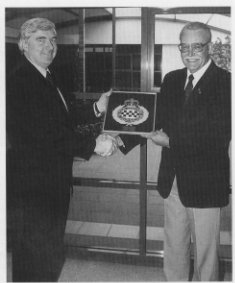
Police Association president, Peter Alexander, presents Bob Wohlenberg with a plaque for his services to the Police Association.
[End]